Abstract
This paper explores how the classical four elements appear in Enochian Magic through John Dee’s diaries. The angelic cosmology aligns with the density order found in earlier occult literature. Visionary episodes (the Four Watchtowers and the Round House) link each element to a compass direction, colour, and an angle of the Great Table. The resulting correspondence (East-Fire, South-Air, West-Water, North-Earth) shows that the elemental framework is a structural core of the Enochian system, echoing earlier Hermetic traditions and informing its internal logic.
Introduction
The classical four elements – earth, water, air and fire – are one of the most fundamental concepts in the western mystery tradition. Cornelius Agrippa in his De Occulta Philosophia – a tremendously influential text in the history of western mystery tradition – dedicates several of its earliest chapters to just this topic.1 This leads us to the question: What place do the four elements have in Enochian Magic? In this paper we will delve into the diaries of Dr John Dee in search for the answer.
The elements in angelic cosmology
The four elements are mentioned many times in Dee’s mystical records, both explicitly and by association. The earliest references can be found already during the transmission of the Mystical Heptarchy, particularly in the descriptions of the Daughters of Light:
The Qualitie of the Earth, and Waters, is my knowledge (…)
The motion of the Ayre, and those that move in it, are all known to me. (…)
I signifie Wisdome: In fire is my Government. I was in the begynning, and shalbe to the ende.2
Similar attributions are found in the offices of the Heptarchic Kings, Princes and their Ministers.3 The Heptarchia is primarily planetary in nature, however linking elements with the planets has already been done by Agrippa, so this is not unexpected.4 The specific associations given by the angels are rather odd and deserve a paper of their own.5 In any case, these tell us that the elements were very much present in the angelic cosmology from its conception.
According to Agrippa, the four elements hold a somewhat hierarchical relationship, where fire is the subtlest of them all, then air, water, and earth.6 This so-called density order of elements can be found in the most ancient Hermetic and Kabbalistic sources, such as Corpus Hermeticum7 and Sefer Yetzirah.8 Unsurprisingly, when describing the so-called Aires around the Earth, the angels said “from the fyre to the erth, there are 30 places or abydings: one above, and beneth an other”,9 indicating a similar view.
In yet another place, the angels enumerate the elements in the density order, followed by the celestial spheres, suggesting that the Earth is the elemental realm below the astral.10 This is further affirmed in the Prayer of Enoch: “And O you ministers and true lights of understanding, governing this earthly frame and the elements wherein we live (…)”.11 More similar references are made with regards to the Great Table, we will discuss those below.
The angels give a special function to the element of fire, which is likened to life or spirit that fills all creation.12 This agrees with Agrippa, who describes it as “invisibly present in all things”.13 Similarly, in Corpus Hermeticum, it stands above the other elements and even the seven planets.14
Finally, one vision stands out, which has thus far not been examined by scholars, and which we shall call the Vision of the Whale, focused around the theme of Dee and Kelley’s ascent to wisdom.15 A full analysis of it is beyond the scope of this paper, but what interests us here is that it explicitly references the four elements.16 Furthermore, the elements are portrayed as beasts to be slain,17 perhaps implying the need to overcome the earthly forces.
Four elements and the Great Table
One of the most controversial subjects in Enochian Magic is that of the elemental assignments of the Great Table. While clearly there are within its hierarchy angels directly linked to the elements,18 they are but a tiny part of the larger structure. Some, following the Hermetic Order of the Golden Dawn, expand these correspondences to cover the four Tables, their sub-angles and even individual squares.19 This approach has been criticised since, as completely unsupported by the diaries.20
Some would argue that the diaries never describe the Tables as elemental in nature.21 Indeed, the link is never explicitly stated; however, there is plenty of evidence in Dee’s diaries to support the idea. One such point, that has been so far largely ignored, is an entry from June 4, shortly before the transmission of the Great Table, where Dee was promised to learn about the governors of the four elements:
Gabr[iel] - You have to receyve the will of God (but what it is, I know not): these three dayes, before you begyne your Iornaye.
And you are, allso, to lerne, what the Angel is, & how many subiects he hath.
[Dee] - Which Angel?
Gab[riel] - That governeth Hyle,
which is the matter of the 4 Elements.
And which onely, is an Element.
The princis and Governors allso of the 4 Elements,
(And of theyre Generation,
How they receyve mixtion,
And in what quantitie)
with theyr ministers that are under them.22
The following days were rather uneventful,23 until on June 20, Kelley received the Vision of the Four Watchtowers.24 There is, therefore, nothing else in the diaries that this promise could refer to, but the Great Table. Furthermore, we are told about governors, princes and their ministers, which suggests a much higher place in its hierarchy than the elemental spirits mentioned before. It follows, then, that the Tables are themselves elemental in nature.
The four Tables are explicitly linked to the four compass directions, as per the Vision of the Four Watchtowers. Such an association already constitutes the grounds for inferring elemental correspondences. This is further affirmed by the colourful carpets rolling out from the four towers, which resemble the elements in the density order (see Table 1).25
| Direction | Colour | Inferred element |
|---|---|---|
| East | Red | Fire |
| South | White | Air |
| West | Green | Water |
| North | Black | Earth |
In another vision, Kelley reports that the same colourful carpets or cloths were covering the Great Table, in a similar order of density:
Now he spreddeth the Ayre, or openeth it, before him, and there appeareth before him a square table.
Now he taketh of the table a blak carpet.
Now he taketh of a green carpet.
Now he taketh of a white carpet.
Now he taketh of a red cloth.
And now the Table appereth to be made of erth, as potters clay, very raw earth.26
How the directions are to be assigned to the different parts of the Great Table is less clear. During the transmission of the Tables, the angels linked the ORO Table directly to the East angle,27 however no such indications were given for the others. Dee seems to have inferred the remaining placement on his own, which can be seen in his Book of Supplications or Invocations.28 In that book, Dee also includes a crucial diagram,29 which shows that the assignments of directions follow the layout of the Great Table.
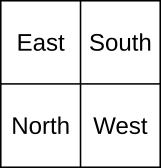
Figure 1: Compass directions on the Great Table.
Further confirmation can be found in the Vision of the Round House, which describes a house with four doors, each representing one of the four directions. Each door also had a number of stairs. East-1, South-2, West-4, North-3.30 This numbering system appears to follow the English way of writing – left to right, top to bottom – which is how the Tables were numbered by the angels.31 Since the directional attributions are thus locked in place, after Dee’s arrangement of the Tables later got corrected by the angels,32 the correspondences must be reapplied according to their positions. This yields the following: ORO-East, MPH-South, OIP-West, MOR-North.
The Vision of the Round House also explicitly links the four directions with the four elements: Each door has a colour and behind each a different element was shown to Kelley. Furthermore, it nearly perfectly fits the model we have inferred above, with one exception – the colours red and white are swapped. Since this discrepancy goes against the previously established density order, it is likely an error in Kelley’s reporting or Dee’s transcription. In any case, the elemental attributions of the four directions are clear.
| Direction | Colour | Element |
|---|---|---|
| East | White | Fire |
| South | Red | Air |
| West | Green | Water |
| North | Black | Earth |
Since each Table is also divided into four sub-angles, the question remains whether these should be assigned elements as well, as has been done in the Golden Dawn. While this seems like a logical extension, we found no substantial evidence in Dee’s diaries to support this idea. We therefore present the following final table of correspondences (Table 3).
| Direction | Table | Colour | Element |
|---|---|---|---|
| East | ORO | Red | Fire |
| South | MPH | White | Air |
| West | OIP | Green | Water |
| North | MOR | Black | Earth |
Conclusion
The classical quartet of earth, water, air and fire proves to be a structural cornerstone of the Enochian system. Throughout Dee’s diaries the angels mention the elements repeatedly, arranging them in the traditional density order found in earlier Hermetic texts. The Great Table represents the earthly realm, with its four Tables themselves linked to the four elements. Recognising this elemental framework clarifies the internal logic of the Enochian system and provides a solid basis for further comparative work with contemporary Hermetic and Renaissance occult traditions.
-
For a modern translation see Heinrich Cornelius Agrippa, Three Books of Occult Philosophy (Eric Purdue, tr., 2021). ↩︎
-
Kevin Klein, The Complete Mystical Diaries of Dr John Dee (2020), lib. III, p. 15. ↩︎
-
The descriptions are all throughout Klein, lib. IV, but see e.g. p. 21, where King Babalel and those under him are assigned the rulership over water. ↩︎
-
Agrippa, book 1, chapter 8. ↩︎
-
In the meantime, for possible explanations see Aaron Leitch, Restoring the Enochian Heptarchia, https://www.llewellyn.com/journal/article/2423. ↩︎
-
Agrippa, book 1, chapter 3. ↩︎
-
Corpus Hermeticum 1:5 in Brian P. Copenhaver, Hermetica (1992), p. 1. ↩︎
-
Sefer Yetzirah 3:4, 6:2 in Aryeh Kaplan, Sefer Yetzirah (1997) p. 145, 243. ↩︎
-
Klein, lib. X, p. 62. ↩︎
-
Klein, lib. VII, p. 8. See also Klein, lib. XI, p. 43. ↩︎
-
Klein, lib. XI, p. 88. ↩︎
-
Klein, lib. IV, p. 23. See also Klein, lib. VII, p. 27. ↩︎
-
Agrippa, book 1, chapter 5. ↩︎
-
Corpus Hermeticum 1:9 in Copenhaver, p. 2. ↩︎
-
Klein, lib. XI, p. 65-70. ↩︎
-
Klein, lib. XI, p. 70. Notably, it also references the 12 Zodiacal signs or houses. ↩︎
-
Klein, lib. XI, p. 68. ↩︎
-
Klein, lib. X, p. 55-56. ↩︎
-
For a full breakdown of the Golden Dawn system of correspondences, see Aaron Leitch, Essential Enochian Grimoire, chapter 12. ↩︎
-
Donald Tyson, Enochian Magic for Beginners (1997) p. 288-294. ↩︎
-
Leitch, p. 19. ↩︎
-
Klein, lib. XI, p. 25. ↩︎
-
Dee and Kelley were commanded to go and visit the Holy Roman Emperor. Dee believed that their failure to meet the deadline set by the angels, resulted in the delay of the following transmissions. ↩︎
-
Klein, lib. XI, p. 33. ↩︎
-
Klein, lib. XI, p. 33, 39. ↩︎
-
Klein, lib. XI, p. 42. ↩︎
-
Klein, lib. XI, p. 48. See also p. 51, where the King Bataiva of the ORO Table is explicitly linked to the East. ↩︎
-
Klein, lib. XXIV. ↩︎
-
Klein, lib. XXIV, p. 10. Note that Dee made an error, placing the OIP Table in the bottom right, instead of the bottom left, as can be seen on p. 9. ↩︎
-
Klein, lib. XIV, p. 3-5. ↩︎
-
See my article Reconstructing the True Great Table. See also Klein, lib. XXIV, p. 8-9, where Dee uses this numbering to correct the arrangement of his Original Table. ↩︎
-
See my article Reconstructing the True Great Table. ↩︎